
County Confusion
Why county confusion took hold
County confusion exists because the word county has been used to describe different things. Historic counties, council areas and lieutenancy areas have often been blurred together under a single term.
They are not the same thing. Once each boundary is named for what it is, much of the confusion disappears.
Three separate layers
Keep each boundary in its own category
- Geographic counties are long-standing county geography.
- Council areas exist for local administration and services.
- Lieutenancy areas are territories used for the lieutenancies.
Why the confusion happens
Three reasons the language became blurred
The confusion is understandable once later administrative systems start borrowing county language. The solution is to separate those systems again.
01 · The problem
One word, several different meanings
The geographic counties long pre-date elected county councils and the statutory local-government areas created from 1888 onwards. Confusion grew as later administrative areas borrowed county names.
02 · The solution
Separate the layers properly
The solution is not to multiply meanings, but to name each thing clearly. County should mean the historic county. Council areas and lieutenancy areas should be described in their own terms.
03 · The principle
County means geography
Much of the confusion begins when council areas are described as counties. That replaces a stable county meaning with a purpose-specific administrative one.
Separate geographical layers
Three things often called counties
These three things are often confused because all have been described using the word “county”. They are not the same.
Geographic counties
Historic counties
The historic counties of England, Scotland, Wales and Ireland are long-standing territories with names, boundaries and identities built over centuries.
They are the counties that council areas and lieutenancy areas are often mistaken for.
Local administration
Council areas
Local-government areas are created and altered by legislation. They exist to provide administration and services, not to define the historic counties.
When local government uses the word county, it does not automatically mean the historic county.
Lieutenancy
Lieutenancy areas
Lieutenancy areas are the territories to which Lord-Lieutenants are appointed as the monarch’s representatives. For centuries they were aligned with the historic counties. Today many follow later local-government boundaries instead.
They do not define the historic counties and should not be treated as counties themselves.
Administrative change
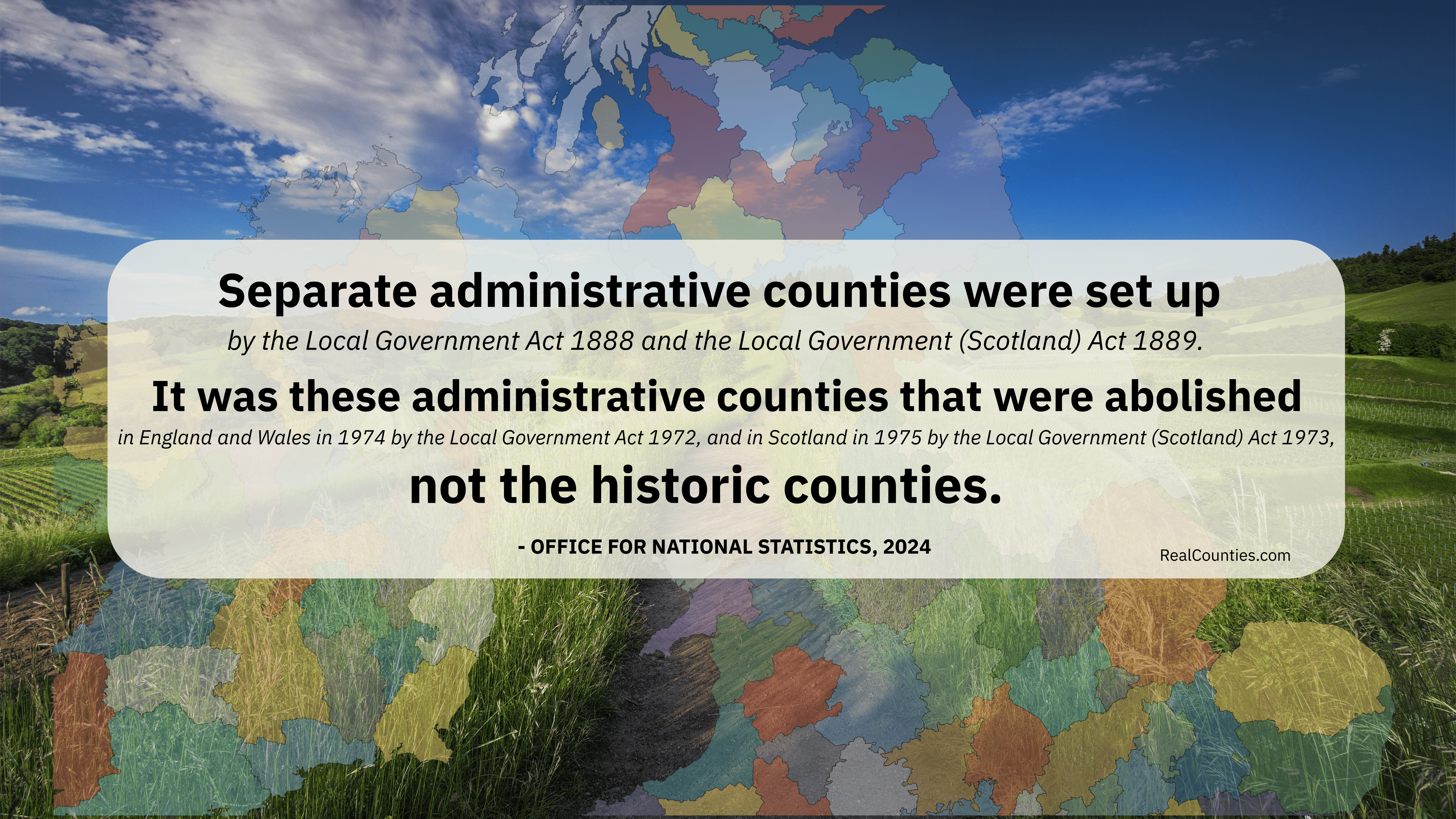
Local-government counties were not the historic counties.
One of the main sources of county confusion is treating local-government counties and county councils as if they were the historic counties themselves.
Administration changed. The geographic counties did not disappear.
Later local-government changes affected council structures and local-government areas. They did not abolish the historic counties.
Public consequences
How confusion spreads
When council areas are described as counties, people are taught to confuse administration with geography. That confusion then spreads into education, maps, media, signs and local identity.
The problem is not that councils exist. The problem is that council areas have been allowed to borrow the language of the counties even when their boundaries are very different.
Precision in public language
What accurate public language looks like
The solution is not to invent more meanings for county. It is to name each boundary correctly.
Administration
Use council terms for council areas
Use council and local-government terms for council areas.
Lieutenancy
Call lieutenancy areas what they are
Describe lieutenancy areas as lieutenancy areas, not as counties.
Geography
Use county for the geographic county
Use county for the historic counties themselves.
Clarity
Name the boundary being discussed
Clear language helps people understand which boundary is actually being discussed.
Go further
See the evidence behind the distinction.
Evidence & Sources brings together the legislation, official statements, maps and records behind these distinctions. Myths & Facts answers the most common claims directly.