

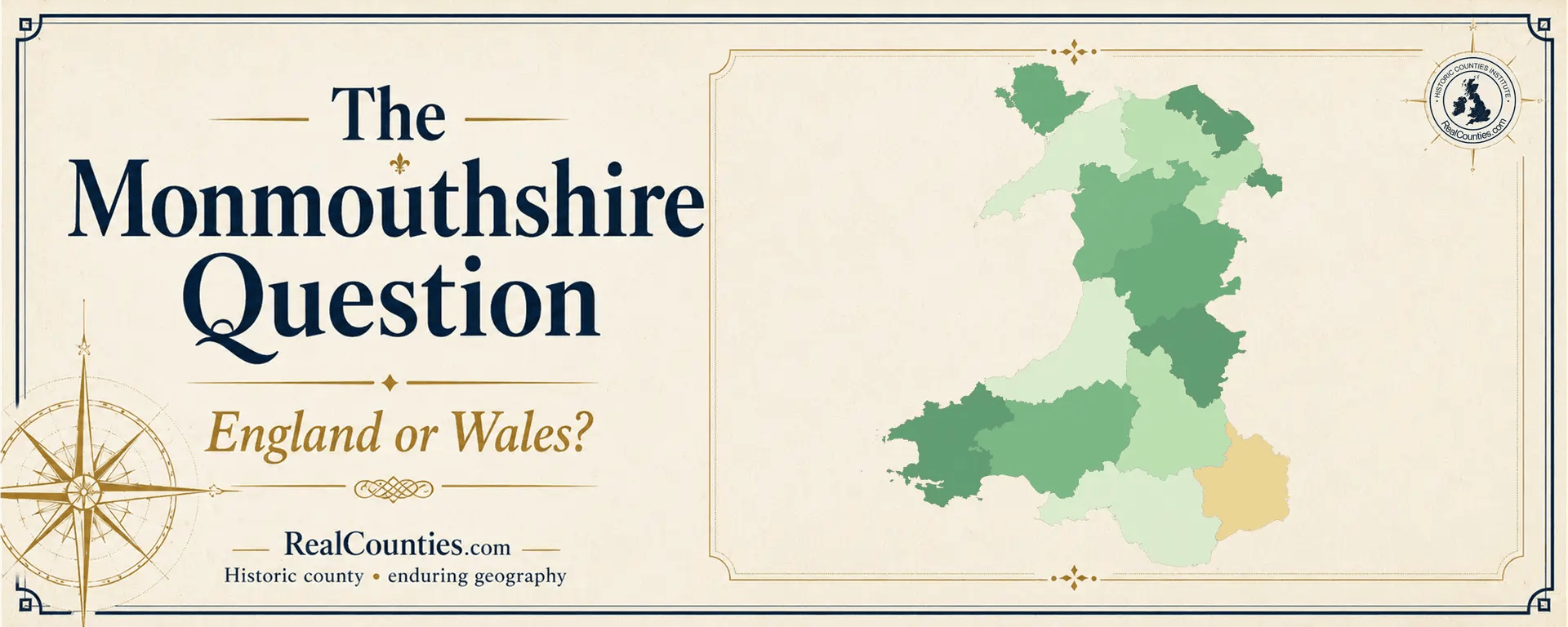
Pip: Historic Counties Institute has a talent for finding the questions that look simple until you actually look at them — and then suddenly you're in a four-hundred-year constitutional argument.
Mara: Today we're covering one of those arguments: where exactly Monmouthshire belongs — England or Wales — and why the honest answer is more interesting than either side usually admits.
Pip: Let's start with the Monmouthshire question itself.
Is Monmouthshire English, Welsh, or Neither?
Mara: The core tension here is that Monmouthshire was formed from Welsh territory under the Laws in Wales Act 1535, but the Tudor settlement that followed listed Wales as twelve counties — and Monmouthshire was not among them. That omission set up centuries of ambiguity.
Pip: So from the very beginning, the county was created out of Wales but then administratively sidestepped out of it — which is the kind of legislative move that keeps historians employed indefinitely.
Mara: The post frames it precisely: "Rather than falling consistently on one side of the England-Wales divide, Monmouthshire developed an anomalous position in which it could be associated with either country depending upon the particular legal, administrative or statistical purpose concerned."
Pip: That single sentence is doing a lot of work. The upshot is that there was no stable, universal answer — the county's identity shifted depending on what question you were trying to answer at the time.
Mara: The census record makes this concrete. The 1851 Census places Monmouthshire in its Welsh Division. But the 1871 Census uses two different headings in the same publication: "ENGLAND (including MONMOUTHSHIRE)" in one set of tables, and "MONMOUTHSHIRE AND WALES" in another.
Pip: The same document, two contradictory framings. That's not confusion — that's the official record faithfully capturing a genuine anomaly.
Mara: Thomas Moule's The English Counties Delineated from 1837 lists Monmouthshire among English counties, yet his own discussion repeatedly acknowledges its Welsh associations. And as late as 1967, Parliament expressly stated that a new provision clarifying England and Wales left Monmouthshire's legal position unaffected — which only makes sense if that position was still considered unsettled.
Pip: Right — if it had been settled, you wouldn't need to say so.
Mara: For the purposes of the new local-government arrangements, the Local Government Act 1972 placed Monmouthshire in Wales from 1974. But that did not retrospectively settle the historic national status of the geographic county, whose earlier England/Wales position remains genuinely ambiguous.
Mara: The conclusion the post reaches is that both flat claims — always Welsh, or definitely English until 1974 — flatten a much more interesting history. The anomaly is the answer, not a gap in the evidence.
Pip: What stays with me is that the ambiguity isn't a failure of record-keeping — it's the record doing its job accurately.
Mara: Exactly. When the evidence is genuinely complicated, the honest description is complicated too. That's the principle behind how historic counties get treated throughout Britain.
Pip: More of that next time.