
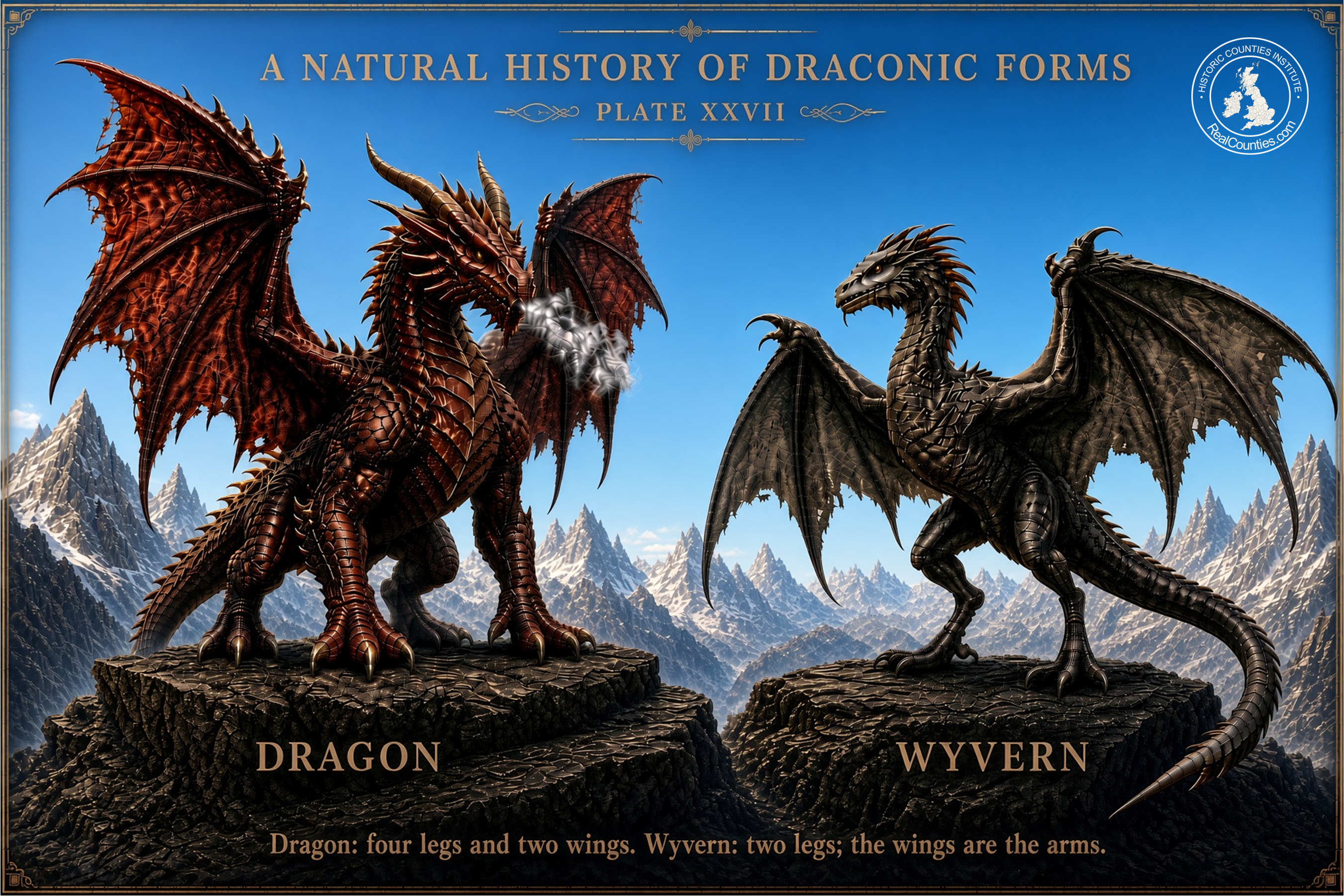

Somerset’s familiar red beast is often called a wyvern. It is not. In English heraldry it is a dragon — and the documentary evidence is unusually clear. The confusion comes partly from Somerset’s deep connection with Wessex, whose modern flag does bear a two-legged wyvern. The two symbols are related, but they are not the same.
Few county emblems are as instantly recognisable as Somerset’s red dragon on gold. It appears on the county flag, at sporting events, on badges and signs, and increasingly wherever Somerset identity is celebrated.
Yet one claim appears again and again: “It isn’t a dragon — it’s a wyvern.”
That is a myth.
In English heraldry there is a straightforward distinction. A dragon has four legs. A wyvern has two. Somerset’s creature has four legs and, more importantly, the authoritative heraldic description from which the modern Somerset emblem developed explicitly calls it a dragon.
The source of the confusion is nevertheless fascinating, because a genuine wyvern is closely associated with the older Kingdom of Wessex — and appears on the modern Wessex flag. Somerset was at the heart of Wessex, so the histories of the two emblems are intertwined.
The result is a story stretching from Anglo-Saxon battle standards and a remarkable ninth-century brooch found near Cheddar to twentieth-century heraldry and Somerset’s present county flag.
The simple difference: four legs or two?
Dragons and wyverns are mythical creatures, so there is obviously no biological classification to consult. The distinction that matters here is the one established by English heraldic convention.
The traditional rule is:
| Creature | Legs | Wings | Typical form in English heraldry |
|---|---|---|---|
| Dragon | Four | Usually | Four-legged, winged reptilian creature |
| Wyvern | Two | Usually | Two-legged, winged, serpent-like creature with a long tail |
Charles Boutell’s Handbook to English Heraldry puts the distinction very clearly: the dragon and wyvern are both winged monsters, but the dragon has four legs whereas the wyvern has two. Boutell also adds an important qualification: in early blazon the distinction was not always consistently observed.
Arthur Charles Fox-Davies made essentially the same point in A Complete Guide to Heraldry. In English heraldry, he explains, a wyvern has only two legs, while its head is fundamentally no different from a dragon’s. He also notes that continental heraldic traditions have not always made the same distinction.
That historical qualification matters. Calling every two-legged dragon-like creature in a medieval source a “wyvern” can be anachronistic. Medieval writers might simply have called such a creature a dragon. The tidy dragon-versus-wyvern classification belongs particularly to later English heraldic terminology.
But when discussing modern English heraldry — including Somerset’s emblem — the distinction is perfectly useful.
And Somerset’s creature is a dragon.
The decisive evidence: Somerset’s heraldic blazon
With heraldry, appearances can sometimes mislead.
An artist may change the curve of a tail, the angle of a wing or the position of a limb. One rendering may be highly detailed; another may be heavily stylised.
That is why heraldry is fundamentally defined not by one particular drawing but by the blazon: the formal verbal description of the arms.
The College of Arms itself explains that once arms have been granted, their form is governed by their concise verbal description rather than by one particular painting. The same arms can therefore be rendered correctly in different artistic styles.
This makes the Somerset question remarkably easy to settle.
On 29 December 1911, arms were granted to the Chairman, Aldermen and Councillors of Somerset County Council. The contemporary record gives the blazon as:
Or, a Dragon rampant Gules holding in the Claws a Mace erect Azure.
In plain English: on a gold field, a red dragon rampant, holding an upright blue mace.
Not a wyvern.
A dragon.
The wording is not an informal nickname applied afterwards. It is the heraldic description of the creature itself.
Why was there a mace?
There is another distinction worth making.
Those 1911 arms belonged to Somerset County Council, a body created for local administration, rather than being arms belonging to the geographic county itself.
The blue mace therefore had a particular purpose: it represented the authority of the council.
A contemporary account published by the Somersetshire Archaeological and Natural History Society described the adoption of the Wessex dragon by the council and specifically noted the addition of the mace to represent the authority of Somerset County Council.
That distinction eventually became important when Somerset acquired a flag intended for the county and its people rather than for a local-government body.
The Somerset county flag
The registered Somerset county flag shows a red dragon on a gold field, without the council’s mace.Som
The Flag Institute’s UK Flag Registry describes it unequivocally as:
a red dragon on a gold field
and identifies the dragon as the traditional emblem of Somerset.
The present flag followed a county-wide competition organised in 2013 by the Somerset County Gazette and Pardoes. The winning design was submitted by Ed Woods, who had already campaigned for a Somerset flag based upon the traditional emblem. The new flag was unveiled in Taunton on 4 July 2013.
The result was an elegant distinction between county and council:
Somerset County Council arms: red dragon on gold, holding a blue mace.
Somerset county flag: red dragon on gold, without the mace.
Removing the mace leaves the county symbol free from the specifically civic element associated with the council.
And, again, the creature remains a dragon.
So where does the wyvern come in?
This is where Wessex enters the story.
Somerset formed a central part of the Anglo-Saxon Kingdom of Wessex. The association between Wessex and a dragon standard is much older than Somerset County Council.
Henry of Huntingdon, writing in the twelfth century, twice referred to a dragon standard in accounts involving the West Saxon royal tradition. Modern medieval scholarship has consequently associated the dragon standard with the kings of Wessex and subsequently with the English monarchy. The University of East Anglia’s Magna Carta Project describes the Wessex royal dragon as appearing at least twice in Henry’s history.
One of Henry’s references concerns the Battle of Burford in 752 and describes the royal insignia as a golden dragon. Another, concerning the Battle of Ashingdon in 1016, places the king in his accustomed position between the dragon and another royal standard.
Notice the terminology.
The medieval source says dragon.
It does not establish a neat modern zoological distinction between a four-legged “dragon” and a two-legged “wyvern”.
That distinction developed within heraldic convention.
The dragon at Hastings
A famous dragon-like standard also appears in the Bayeux Tapestry, close to King Harold during the depiction of the Battle of Hastings in 1066.
Harold had been Earl of Wessex before becoming king, and the standard has long been associated with the English or Wessex dragon tradition.
The Magna Carta Project considers the dragon shown beside Harold very likely to represent the same royal dragon tradition described by Henry of Huntingdon.
There is, however, room for scholarly caution.
Dragon and serpent standards were not unique to Wessex. They existed elsewhere in early medieval Europe, ultimately drawing upon much older military traditions, including the Roman draco. Scholars examining the Bayeux Tapestry have also warned that not every dragon-like device shown within it can automatically be labelled a Wessex emblem.
The sound historical conclusion is therefore not that every medieval wyvern-shaped creature was “the flag of Wessex”.
It is that a dragon standard has a well-attested association with the West Saxon and later English royal tradition, while the precise appearance and significance of individual medieval representations must be judged from their evidence.
Why does the Wessex flag show a wyvern?
The familiar modern Wessex flag is much newer than the kingdom whose identity it celebrates.
The Flag Institute records the present Wessex flag as dating from 1974, designed by William Crampton. It consists of a gold wyvern on a red field and is registered as a regional flag.
That distinction is extremely important.
The gold wyvern on red is a modern heraldic and vexillological representation of the older Wessex dragon tradition. It should not be described as an eighth-century flag that has somehow survived unchanged to the present day.
The medieval evidence speaks of dragons and dragon standards. The modern Wessex flag expresses that tradition in the specifically two-legged form that English heraldry calls a wyvern.
So both statements can be true:
Wessex has a historic association with the dragon.
The creature on the modern Wessex flag is, in English heraldic terms, a wyvern.
There is no contradiction.
The remarkable Cheddar Brooch
An extraordinary archaeological discovery in Somerset has added another dimension to the story.
In 2020, a metal detectorist discovered a large early medieval brooch on farmland near Cheddar. Dating from about AD 800–900, it belongs to the period when Wessex was fighting for survival against Viking armies and when Somerset played a pivotal role in the kingdom of Alfred the Great.
Following conservation, the brooch was acquired by the Museum of Somerset.
Its decoration includes interwoven animal forms which the Museum describes as wyverns — dragon-like creatures with two legs, wings and long tails. The Museum notes that this type of creature would later become one of the symbols of Wessex.
It is a wonderfully evocative find.
A two-legged dragon-like creature was therefore being depicted in Somerset itself during the Anglo-Saxon period.
But archaeological evidence should not be made to say more than it can.
The Cheddar Brooch does not, by itself, prove that every such animal was an official royal badge of Wessex, nor that Somerset already possessed a county flag bearing the creature in the ninth century. It demonstrates the presence of precisely this kind of imagery in the cultural world of Anglo-Saxon Somerset.
That is significant enough without embellishment.
Dragon standards came before heraldry
Part of the confusion surrounding dragons and wyverns results from attempting to impose later heraldic terminology upon an earlier age.
The Anglo-Saxon dragon standard existed before the mature system of hereditary heraldry.
Some early dragon standards were probably three-dimensional or windsock-like objects rather than flags in the modern sense. Dragon standards themselves had a much wider history in Europe, with antecedents in the Roman draco.
Only later did heraldry establish increasingly precise rules for depicting and describing fantastical creatures.
This explains why an early chronicler may describe a dragon, while a modern herald looking at a later artistic reconstruction may call its two-legged form a wyvern.
Neither necessarily needs correcting. They are speaking within different conventions.
And that explains the Somerset confusion
The persistent description of Somerset’s dragon as a wyvern probably has several causes.
First, Somerset and Wessex genuinely share historical symbolism. The Somerset dragon was consciously chosen with Wessex in mind.
Second, the modern Wessex flag really does bear a wyvern, so it is easy to assume that Somerset must use the same creature.
Third, dragons and wyverns are visually similar. Both can have wings, reptilian bodies, long tails, claws and fierce heads.
And fourth, terminology has not always been consistent through history. Even respected older heraldic writers acknowledge that the dragon–wyvern distinction was not invariably maintained in early blazon.
But none of those facts changes the identity of the Somerset emblem.
The historic council blazon says dragon.
The present county flag is described by the Flag Institute as a dragon.
And the beast is depicted in the four-legged form of an English heraldic dragon.
Somerset dragon and Wessex wyvern: related, but distinct
The easiest way to remember the distinction is to put the two modern flags side by side.

Somerset
Red dragon
Four legs
Gold field
Registered county flag selected by public competition in 2013
Based upon Somerset’s established dragon emblem
Wessex
Gold wyvern
Two legs
Red field
Modern regional flag dating from 1974
Represents the much older West Saxon dragon tradition
The reversed colours reinforce the distinction visually: red on gold for Somerset; gold on red for Wessex.
They belong to the same broad family of symbolism, but they identify different things.
Somerset is a historic county.
Wessex was an Anglo-Saxon kingdom and remains a historic regional identity.
The fact that Somerset once formed a central part of Wessex explains the relationship between their symbols. It does not make their modern flags interchangeable.
Myth busted: the Somerset beast is a dragon
So the next time somebody insists that Somerset’s emblem is “actually a wyvern”, there is a very simple answer.
No: it is a dragon.
In English heraldry, the conventional distinction is that a dragon has four legs while a wyvern has two.
More decisively still, Somerset County Council’s 1911 heraldic grant expressly describes its creature as “a Dragon rampant Gules”. The registered Somerset county flag retains that red dragon while dispensing with the council’s blue mace.
A wyvern does, however, have a genuine place in the story.
The modern Wessex flag bears a gold, two-legged wyvern, representing the much older dragon tradition associated with the West Saxon kings. Anglo-Saxon Somerset has even produced remarkable archaeological evidence of similar two-legged creatures in the decoration of the ninth-century Cheddar Brooch.
That shared history is precisely why the confusion is understandable.
But the distinction is clear:
Wessex flies the golden wyvern. Somerset flies the red dragon.
And Somerset’s dragon should be allowed to keep all four of its legs.
You must be logged in to post a comment.