

Update — September 2026: The Government has since launched a review of its local-government reorganisation decisions and paused plans across the affected areas. The July position described in this article should therefore be read as the position at the time, not as the final implementation position.
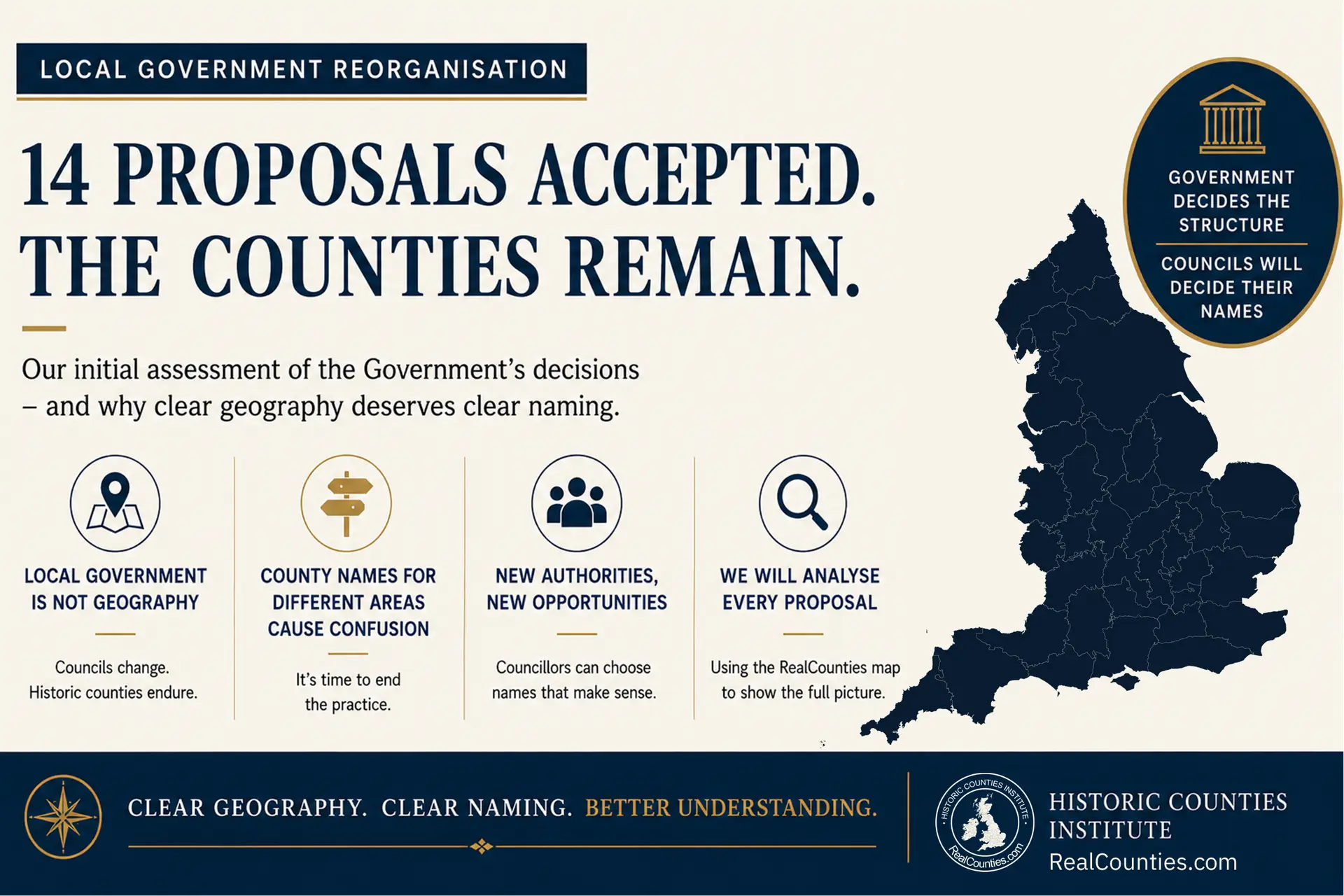
The Government has now confirmed 14 of the 16 proposals in its latest programme of local government reorganisation, with decisions on the remaining two areas still to come. Over the coming weeks, we will examine each proposal in detail using the RealCounties map, comparing the new authorities with the historic counties, existing council boundaries and lieutenancies.
This is not that detailed analysis.
Instead, these are our first impressions – and why we believe this reorganisation matters for far more than local government. Local government is changing. The counties are not.
These proposals concern the structure of local government. They determine which councils will deliver local services and how those councils are organised.
They do not change Britain’s historic counties.
That distinction has existed since county councils were first established in 1888. Administrative arrangements have been reorganised many times since then, but the historic counties have remained Britain’s enduring geographical framework. Modern government guidance continues to recognise them as a stable, unchanging geography.
Understanding that distinction is essential before judging the proposals.
Our initial impression
Having reviewed the accepted proposals, one conclusion stands out. The Government has largely missed an opportunity to reduce one of the greatest sources of geographical confusion in Britain.
For decades, successive reorganisations have reused the names of historic counties for administrative bodies that are not those counties. That practice has blurred the distinction between geography and administration.
It has led countless people to believe that counties have been abolished, replaced or repeatedly altered, when in reality it is local government that has changed. Unfortunately, our first reading suggests that many of the new authorities continue exactly the same pattern.
The problem is not reorganisation
It is important to be clear about what concerns us. We are not opposed to local government reform.
Councils exist to administer services, and governments are entitled to reorganise them if they believe there is a better way to do so.
Our concern lies elsewhere.
It is with the names attached to those administrative bodies. When a council adopts the name of a historic county but governs a different area, the public naturally assumes the council and the county are one and the same. That misunderstanding has persisted for more than fifty years. This reorganisation presented an opportunity to move beyond it.
Administrative areas deserve administrative names
Historic counties and local authorities perform entirely different functions. One is a permanent geographical framework. The other is an administrative structure that governments may alter whenever they choose. They do not need to share the same names.
Indeed, they probably should not.
Authorities should be named according to the areas they actually administer, rather than borrowing the identities of historic counties whose geography they do not represent. Doing so would make Britain’s administrative map easier to understand while allowing the historic counties to continue fulfilling their distinct geographical and cultural role.
Clear geography deserves clear naming.
There is no single verdict
Not every proposal raises the same concerns. Some appear relatively coherent, bringing together existing council areas without creating entirely new geographical complications. Others immediately raise questions about naming, identity and public understanding. That is why broad headlines only tell part of the story. Each proposal deserves to be examined individually. That is exactly what we will be doing.
Our analysis will focus on geography
Most discussion surrounding these reforms has focused on politics, finance and service delivery. Those are important questions. Our focus is different.
For each proposal we will ask:
- Does the authority cross historic county boundaries?
- Does its proposed name accurately describe the area it governs?
- Does it reinforce or reduce public confusion?
- How does it relate to existing council areas and lieutenancies?
- Could a different name provide greater geographical clarity?
These are questions that rarely receive the attention they deserve, despite influencing how millions of people understand the places they live.
The story does not end with the Government’s announcement
There is another important point that has received little attention. The Government has approved the structures of the new authorities. That does not necessarily mean their names are fixed forever.
Once the new councils are elected, it will be for those authorities themselves to determine many aspects of their identity, including the names under which they operate. That means there is still an opportunity to improve matters.
Councillors will be able to choose names that accurately describe the areas they administer, rather than continuing the long-standing practice of borrowing historic county names for different administrative geographies. For many areas, the conversation about naming has only just begun.
What happens next?
Over the coming weeks, we will publish detailed assessments of every accepted proposal. Using the RealCounties map, we will show precisely how each new authority compares with the historic counties and explain where names and boundaries work well – or where they risk creating unnecessary confusion.
Our aim is not simply to comment on local government reform. It is to help ensure that Britain’s administrative geography becomes easier to understand. Local government will continue to evolve, just as it always has.
The historic counties will remain.
The challenge now is to ensure that the names chosen for the new authorities help people understand the difference between the two – not blur it.
If this reorganisation leads to clearer naming and a clearer understanding of Britain’s geography, it will be remembered as more than a change to council structures. It will have become an opportunity to correct decades of misunderstanding.