
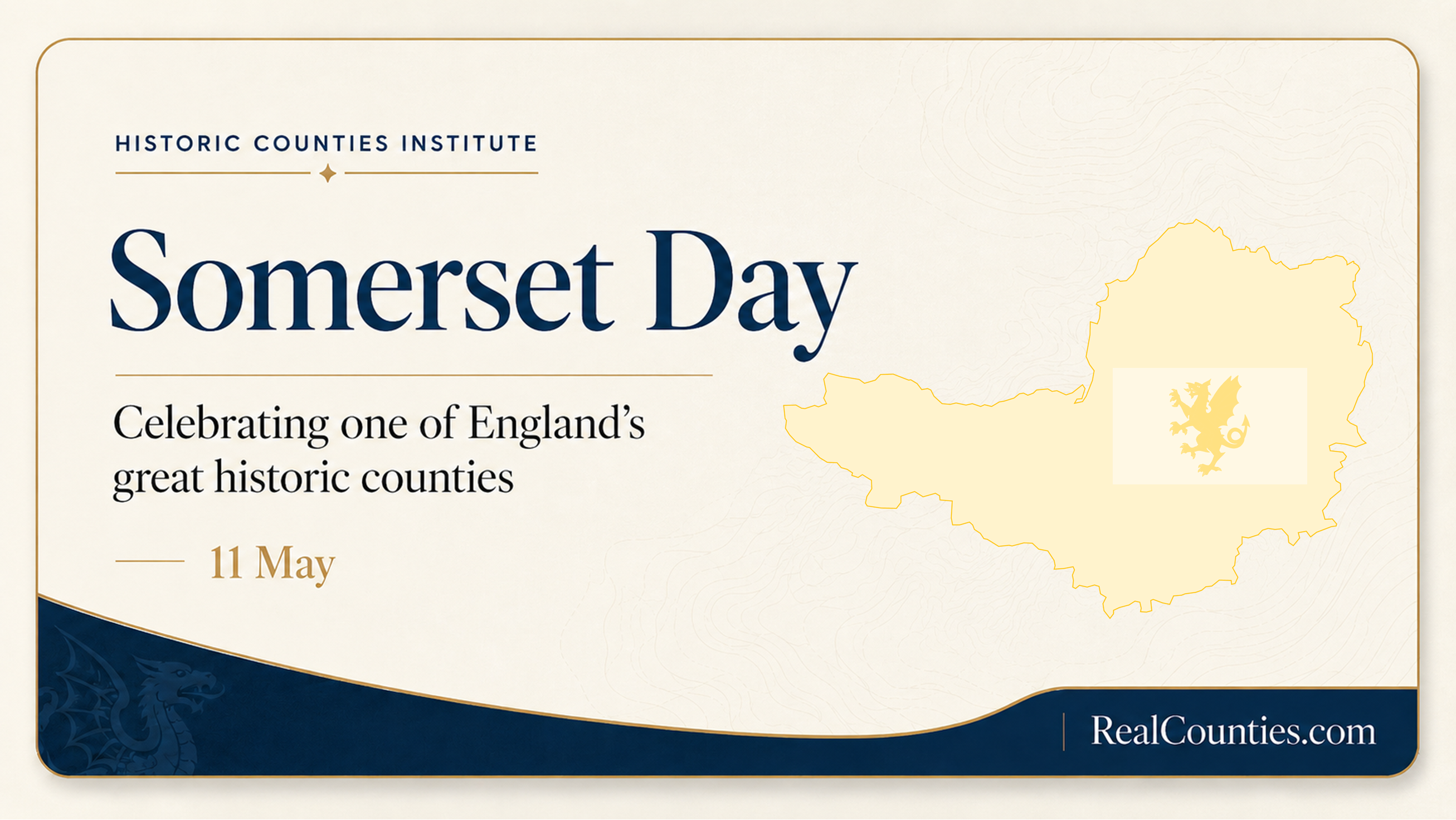
The Historic Counties Institute has marked Somerset Day by celebrating the county’s enduring identity, history and place in the life of England – a celebration of one of England’s great historic counties.
Somerset Day is held each year on 11 May and is celebrated over the second weekend in May. The date recalls Alfred the Great’s call to arms and the gathering of “all the people of Somerset” against the Viking army. It was chosen by public vote in 2015, when more than 8,000 people took part.
This year’s celebrations again show the strength of county identity across Somerset – from flags, events and community gatherings to the work of local businesses, schools and civic groups. Somerset Day’s organisers describe the occasion as an opportunity to celebrate Somerset’s economy, history, heritage, beauty and culture.
For the Historic Counties Institute, Somerset Day is also a reminder of why the historic counties matter.
Somerset is not a council area or a set of local-government boundaries. It is one of England’s historic counties: a long-established geographic county with deep roots in law, history, identity and popular usage.
From Exmoor and the Quantocks to Wells, Taunton, Yeovil, Frome, Bath, Weston-super-Mare and the Mendips, Somerset’s identity remains far older and stronger than the administrative arrangements that have come and gone around it.
A spokesperson for the Historic Counties Institute said:
“Somerset Day is exactly the kind of celebration we want to see across the country. It is positive, local, historic and rooted in real county identity.
“People understand Somerset as a county because it is one. Its meaning does not depend on the boundaries of a council, a unitary authority, a lieutenancy area or a temporary administrative structure.
“Somerset Day reminds us that counties are not simply bureaucratic conveniences. They are part of the inherited geography of the country – places of belonging, memory, landscape, culture and community.
“We warmly congratulate everyone involved in Somerset Day and encourage people across the historic county to fly the flag, learn the county’s history, support local events and celebrate Somerset with pride.”
The Historic Counties Institute argues that public bodies, media organisations and educational institutions should take care to distinguish clearly between historic counties and council areas.
Current councils are important bodies for delivering public services, but they are not the same thing as the counties themselves. Administrative boundaries can change; historic county identity endures.
The Office for National Statistics has recognised the historic counties within its Index of Place Names, describing them as a stable geography covering Great Britain.
The Institute says Somerset Day is a model example of how county identity can be celebrated in an inclusive, civic and historically informed way.
The spokesperson added:
“Every historic county deserves the same respect. Somerset Day shows what happens when people rally around their county as a real place — not as a government unit, but as a shared inheritance.
“On Somerset Day, we say very simply: Somerset is Somerset. Its history, identity and geography deserve to be recognised, understood and celebrated.”
ENDS
Notes for editors
Somerset Day is held annually on 11 May and is organised by Passion for Somerset CIC, a not-for-profit Community Interest Company dedicated to celebrating Somerset’s heritage, culture, economy and communities.
The Historic Counties Institute promotes the recognition, understanding and use of the historic counties of Great Britain as enduring geographical counties, distinct from modern local government areas.