
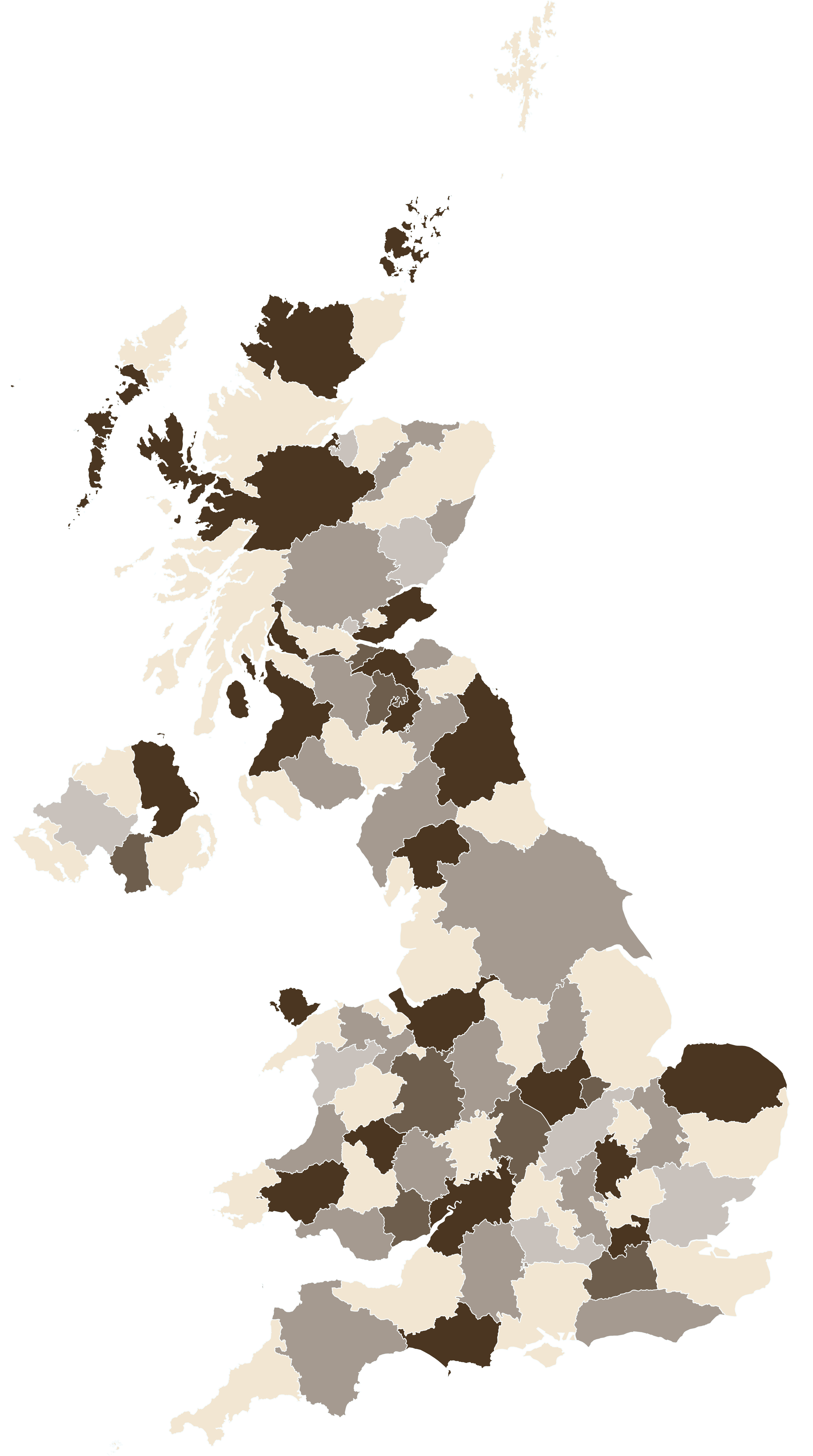
County Origins
For over a thousand years, the counties of England, Scotland, Wales, and Northern Ireland have shaped our landscape, culture and sense of belonging. More than lines on a map – they are living identities, connecting us with our shared past. Yet today, these counties risk being forgotten. Let’s rediscover their story, together.

England
✨ Began in Wessex c650-850
👑 Many were former kingdoms
⚔️ Expands to Mercia 9th-10th Cs
📜 North = Ches & Yorks 1086
🏞️ Other northern counties 12th C
🖋️ Rutland first recorded 1159
A land of shires, conquest, and centuries-old local identity. 🏰🌿
Read More
The division of England into shires began in Wessex in the mid-Saxon period, many of the Wessex shires representing previously independent Kingdoms. With the Wessex conquest of Mercia in the 9th and 10th centuries, the system was extended to central England.
At the time of the Domesday Book, northern England comprised Cheshire and Yorkshire (with the North East being unrecorded). The remaining counties of the North (Westmorland, Lancashire, Cumberland, Northumberland, Durham) were established in the 12th century.
Rutland appears in the Domesday Book, but is first recorded as a county in 1159.
Scotland
✨ Sheriffdoms established >1107
🏰 Royal castle = Sheriff’s base
⚖️ Justice, military, finance, admin
📍 13th C, south & east covered
🌄 Highlands & Isles early 16th C
🖋️ Sheriffdom = shire = county
A land of castles, law, and enduring local identity. 🏔️⚔️
Read More
The Scottish counties have their origins in the ‘sheriffdoms’ first created in the reign of Alexander I (1107-24) and extended by David I (1124-53).
The sheriff, operating from a royal castle, was the strong hand of the king in his sheriffdom with all embracing duties – judicial, military, financial and administrative.
Sheriffdoms had been established over most of southern and eastern Scotland by the mid 13th century.
Although there was a degree of fluidity in the areas of these early sheriffdoms, the pattern of sheriffdoms that existed in the late medieval period is believed to be very close to that existing in the mid-nineteenth century.
The central and western Highlands and the Isles (where resistance to Government was strongest) were not assigned to shires until the early modern period, Caithness becoming a sheriffdom in 1503 and Orkney in 1540.
Wales
✨ Laws in Wales Act 1535
👑 Lawless Marches scrapped
🏰 5 new counties from their lands
📜 8 others from 13th-century
🖋️ Based on ancient Welsh areas
🏛️ First seats in Parliament
A land of ancient communities, law, and evolving governance. 🏞️⚖️
Read More
The present day pattern of the historic counties of Wales was established by the Laws in Wales Act 1535, an Act passed by King Henry VIII to curtail the power of the Marcher Lords who previously ruled over the area of the Marches.
Over time, marcher lordships became lawless havens – outside both English and Welsh law, so Henry VIII abolished them and took control himself. This Act abolished the powers of the lordships of the March and established the Counties of Denbighshire, Montgomeryshire, Radnorshire, Brecknockshire and Monmouthshire from the areas of the former lordships.
The changes also meant that Wales had representation in Parliament for the first time.
The other 8 counties had, by then, already been in existence since at least the 13th century.
The historic counties are, however, based on much older traditional areas – and are therefore a direct link with the ancient Welsh commotes and cantrefs, from which the counties were created.
N Ireland
✨ Shaped in early 1600s
👑 NI = 6 of 9 Ulster counties
🏰 Each from older Irish territories
📜 Part of the shiring of Ulster
🖋️ Governance, law, taxation
🏞️ Modern NI from ancient regions
Castles, ancient territories, and enduring county identities. 🏰🍀
Read More
The division of Ireland into counties began during the reign of King John (1199- 1216). This process continued for several hundred years, as more of Ireland came under the control of the English crown.
Munster was divided into counties in 1571 and Connaght in 1579. Finally Ulster was shired during the reign of James I.
The complete set of counties as they are today were laid down in 1584 (with their modern boundaries not finally settled until 1605, or 1613 in the case of Londonderry albeit that it had existed as part of County Coleraine from Anglo-Norman times).
As in Wales, the counties were generally based on earlier, traditional areas.
Why Counties Still Matter
In the words of Gustav Mahler: “Tradition is not the worship of ashes, but the preservation of fire”. Our counties are not relics of the past – they are part of who we are. They connect us to our landscapes, our families, and our shared story as a nation. Let’s protect and celebrate them before they fade from memory.
Timeline
By the 9th Century
Kingdom of Wessex – foundations of counties, many from previously independent kingdoms
9th-10th Century
Wessex conquers Mercia, system extended to central England
12th Century
Scotland: first ‘sheriffdoms’ created by Kings Alexander I and David I
England: Northern counties of Westmorland, Lancashire, Cumberland, Northumberland, Durham established. (Cheshire and Yorkshire already existed). First record of Rutland as county, 1159
By the 13th Century
Wales: First 8 counties from *at least* 13th Century.
13th Century
Ireland: Shiring begins in reign of King John (1199-1216)
Scotland: Sheriffdoms in place across most of south and east
16th Century
Scotland: Caithness became a sheriffdom 1503, Orkney 1540
Wales: Laws in Wales Act 1535 – Henry VIII seizes control of lawless border lands (marches), abolishes lordships, replacing them with the final five Welsh counties, based on ancient Welsh lands
1540s: Office of Lord Lieutenant created, appointed to each historic county
Ireland: Province of Munster shired 1571, Connacht 1579
17th Century
Ireland: modern county boundaries finally settled 1605, with exception of Londonderry, settled 1613
18th Century
Ordnance Survey (OS) established 1791: primary aim of mapping Great Britain on a scale of 1 inch to 1 mile
19th Century
Notes to the 1831 Census state: “From the Domesday Book of the Conqueror (AD 1086) it is known that County limits have since that time undergone no alteration; in fact they have been jealously maintained.”
Great Britain and Ireland: the OS surveyed on a county-by-county basis – and the boundaries depicted on the First Edition maps form the first definitive, topographically accurate mapping of the borders of the historic counties
1844: The Counties (Detached Parts) Act removes tiny detached parts, locally situate in other counties. Removal of detached parts is the *only* legislative change ever made to historic county boundaries.
1888, 1889, 1898 Local Government Acts: first ‘county councils’, separate from counties, but unhelpfully termed ‘administrative counties’, which sowed seeds of confusion.
19th-20th Century
Small changes to the local government areas began almost as soon as the legislation was passed – hence boundaries increasingly diverged from those of the historic counties. Inevitably, although the 19th Century ‘administrative counties‘ existed alongside the historic counties, their existence with increasingly divergent boundaries was another recipe for mass county confusion.
20th Century
1891, 1901, 1911 censuses: detailed statistics by ‘administrative county’ and historic county – clearly indicating the General Register Office (GRO) did not consider the 19th Century Local Government legislation to have affected the existence or areas of the historic counties, even coining the phrase ‘ancient or geographical county’ to differentiate from ‘administrative county’.
Representation of the People Act 1918: Members of Parliament no longer elected by historic county, which had been the practice for the best part of 600 years.
In contrast to the General Register Office, Ordnance Survey changed their definition of ‘county’ in the decades following the introduction of Local Government. They decided it now meant ‘lieutenancy area‘. As the counties pre-date the 1540s office of Lord Lieutenant by many centuries, this is clearly nonsensical. It also means that, when lieutenancies are linked to local government (as they are currently), OS ‘counties’ change with local government changes. This is what led to the complete removal of anything like the historic counties from OS maps following the 1970s local government reorganisations.
1970s: Local Government reorganisation – resulting in more confusion and the destruction of many true county identities.
1 April 1974: “The new county boundaries are administrative areas, and will not alter the traditional boundaries of counties, nor is it intended that the loyalties of people living in them will change despite the different names adopted by the new administrative counties.” Government Statement.
1997: Lieutenancies Act – resolves the side-effect of new unitary councils dropping out of their lieutenancy as a result of leaving a ‘County Council’ area (because post-1974, lieutenancies are tied to local government areas). This Act makes it simple to realign the lieutenancies to the historic counties, as was the practise for 400+ years.
21st Century
2013: Law amended to allow county flags to be flown without council permission;
2013: Planning Guidance changed to allow historic county boundary signs to be erected;
2014: Inaugural Historic County Flags Day 23 July
2015: ‘Historic Counties Standard’ published by the Historic Counties Trust: a comprehensive definition of the names, areas, and borders of the UK’s historic counties
2021: House of Lords Questions on historic counties
2025: House of Commons Motion supporting historic counties, their preservation and promotion
21st Century
Office for National Statistics: revised ‘Index of Place Names’ includes historic counties (latest edition 2024). The ONS also now explicitly recommend the historic counties as a fixed geographical reference, stating:
“The historic counties of Great Britain…have existed largely unchanged since the Middle Ages. They are recommended as a stable, unchanging geography which covers the whole of Great Britain.”
 Campaign for Historic Counties